

What Is Metasploit?
The Metasploit Project is a cybersecurity tool designed for penetration
testing and vulnerability assessment. Owned by Rapid7, a US-based
security firm, Metasploit provides data about security flaws and helps ethical
hackers test systems. A key subproject is the open-source Metasploit
Framework, which allows penetration testers to develop and run exploit code
on remote targets.
Metasploit comes with anti-forensics
and remediation tools and is pre-installed on Kali Linux for
cybersecurity professionals.
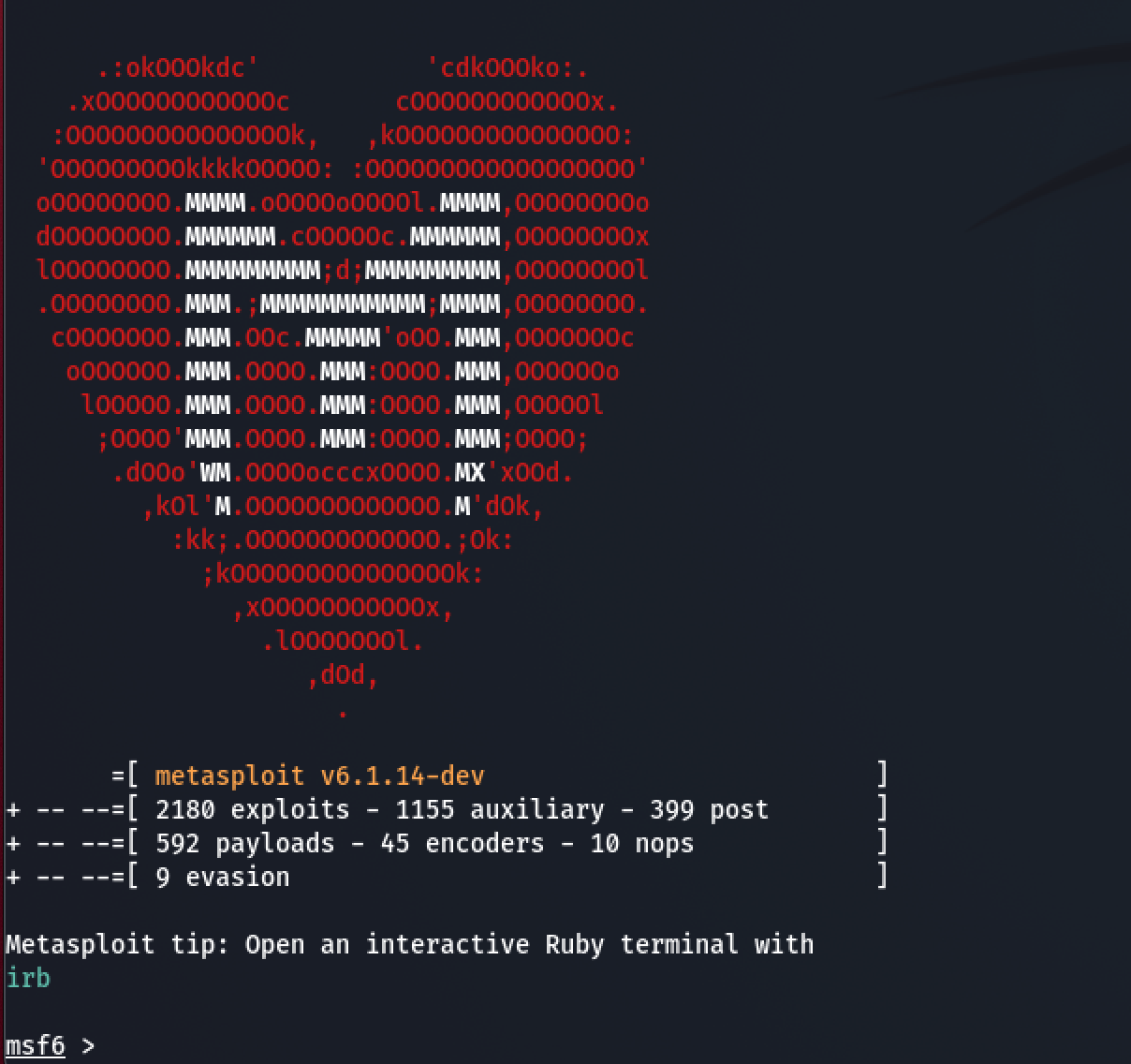
Metasploit Loading Screen
Benefits
of Penetration Testing Using Metasploit
- Open Source
– Metasploit is fully open-source, allowing pentesters to customize
modules, access source code, and add new functionality.
- Smart Payload Generation – Using commands like setpayload and the MsfVenom tool, testers can easily
switch payloads and generate shellcode for manual exploitation.
- Clean Exits and Persistence – Metasploit can exit without detection and provides
methods to maintain access on target systems.
- Visual UI
– GUIs like Armitage allow testers to visualize targets, manage
vulnerabilities, and automate repetitive tasks.
7
Components of the Metasploit Framework
- MSFconsole
– The main command-line interface for scanning, exploiting, and network
reconnaissance.
- Exploit Modules
– Target specific vulnerabilities like buffer overflows or SQL injection.
- Auxiliary Modules
– Perform additional tasks like scanning, fuzzing, and denial-of-service
attacks.
- Post-Exploitation Modules – Extend access and gather data from the target
system.
- Payload Modules
– Execute shellcode, including Meterpreter, for advanced
exploitation.
- No Operation (NOPS) Generator – Helps bypass IDS/IPS systems.
- Datastore
– Central configuration for storing module parameters and variables.
Tools
Offered by Metasploit
- MSFconsole
– Primary CLI for interacting with the framework.
- msfdb
– Database tool for storing host data, exploit results, and scan outputs.
- MsfVenom
– Generates custom payloads to bypass firewalls and antivirus systems.
- Meterpreter
– Advanced in-memory payload that supports encrypted communication, file
access, webcam capture, and scripting.
- Armitage
– Java-based GUI for visualizing targets, recommending exploits, and
automating penetration tests.
How
to Use Metasploit
Metasploit integrates with tools
like Nessus and Nmap for reconnaissance. Once a vulnerability is
identified, testers choose an appropriate exploit and payload.
Post-exploitation tools allow persistent backdoors, packet sniffing, privilege
escalation, screen capture, and more.
Metasploit is modular and
extensible, meaning users can adapt it for specific penetration tests or
create custom modules as needed.
Challenges
with Metasploit
- Legal Use Only
– Only use Metasploit on systems you are authorized to test. Unauthorized
use is illegal.
- Potential System Impact – Exploits may cause crashes, restarts, or denial of
service on target systems. Always have emergency plans in place.
- Coverage Limitations – Metasploit’s 2,000+ exploits cover only a fraction of real-world vulnerabilities. Custom modules may be needed for complete testing
Metasploit
Summary
Metasploit is an essential tool for ethical
hackers and cybersecurity professionals, offering powerful exploitation,
payload, and post-exploitation capabilities. While highly effective, it
requires legal authorization, proper training, and careful handling to
avoid unintended consequences.
0 Comments